Ignoring integration gaps means you risk losing employee trust and engagement long before any report or survey signals a problem.

When enterprise communication tools aren’t well integrated, employee trust in leadership starts to erode long before productivity slips. The real damage happens quietly, showing up in engagement and morale before any numbers change.
Enterprise communication systems only work if a message sent on one tool actually lands where the next person is looking for it.
When that handoff breaks, nothing dramatic happens right away — a chat message sits in a channel nobody checks, an email gets answered on a phone that never syncs back to the desktop thread.
That small gap doesn't stay small. It repeats itself, once a week, then a few times a day, and each repeat costs someone a few minutes of hunting and a little bit of confidence that the system has their back.
We think that's where the real damage starts — not in the productivity numbers, but in how people read the gap. Employees notice when tools don't talk to each other, even if they can't put a name to what's bugging them, and they quietly start filing it under "leadership doesn't really see what my day looks like."
Dashboards and surveys won't catch that early. By the time a number moves, the feeling's already been sitting there a while, showing up in the way people talk to each other, or stop talking, long before it shows up anywhere you'd think to look for it.

Most businesses watch for the obvious symptoms in their communication setup — a dropped call, a lost file, a meeting nobody got the link for. Underneath that, there's a cost that never makes it onto a balance sheet.
Every time someone has to jump between platforms just to finish one task, it tells them something about how the whole thing was put together. It suggests nobody sat down and thought through how people actually talk to each other during a normal workday, and that impression compounds every time they have to repeat themselves or go chasing an update across three different apps.
That builds into a quiet kind of frustration, the sort that makes people wonder if their time is even being respected. The output numbers can look perfectly fine while the trust underneath them is already thinning out.
None of that shows up fast. By the time it turns up in a survey or a review, the wear's already happened, and swapping one tool for another won't fix it on its own — you have to understand how these systems shape the way people actually relate to each other at work.
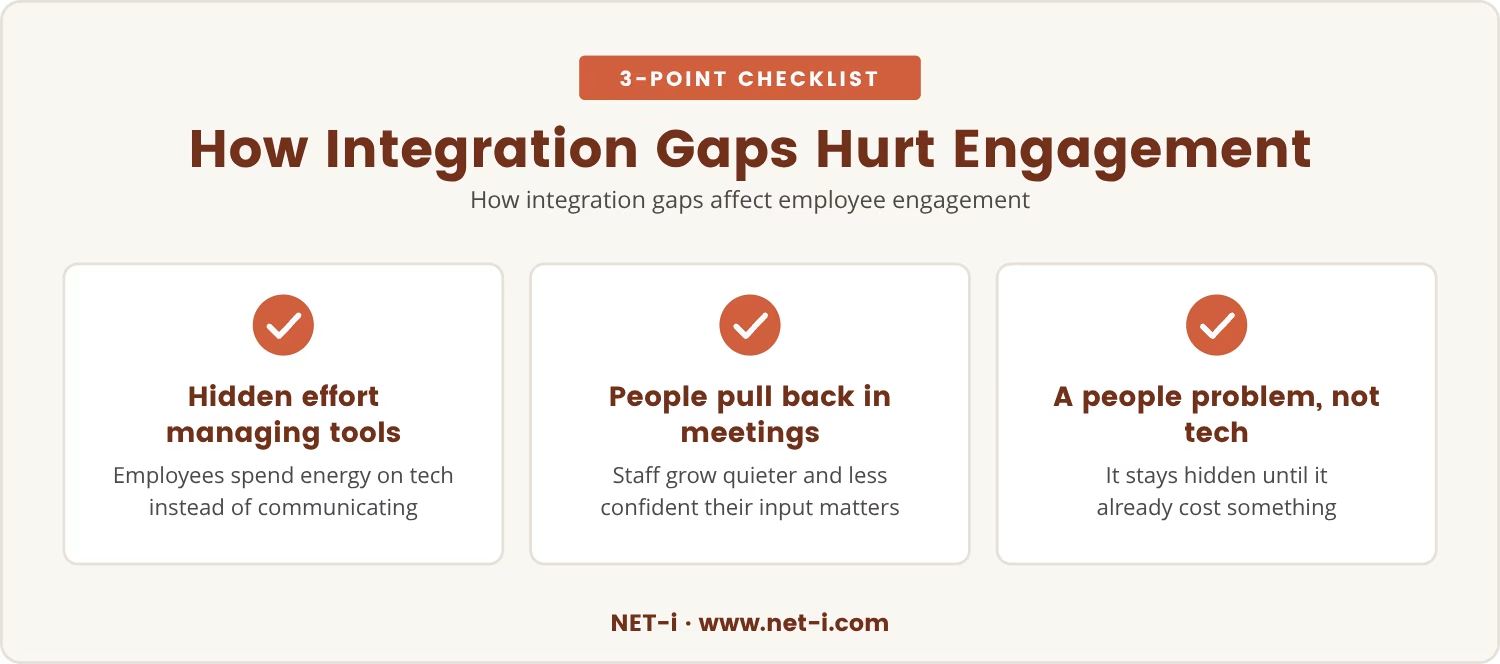
Integration gaps in communication technology trends do more than slow the work down — they change how people feel about doing the work at all. When the tools don't connect, employees end up spending real energy managing the technology instead of just communicating through it.
Most of that effort stays invisible. It shows up as a missed update here, a slower reply there, and each one on its own looks like nothing. Stacked together over weeks, though, they leave people feeling like they're fighting the system instead of using it.
As that frustration builds, engagement drops right along with it. People get quieter in meetings, slower to raise a hand, less sure their input changes anything. It isn't a technical problem at that point — it's a people problem, and it tends to hide until it's already cost you something.
For businesses in Arkansas, how enterprise communication systems get set up can shift team morale one way or the other. Local teams often work across different locations, mixing internet-based communication with voice communication technology just to stay in the loop.
When those pieces don't talk to each other, people feel it directly. They miss updates that mattered, or start to feel like they're on the outside of a conversation the rest of the team is having — a risk that only grows for organizations leaning on remote or hybrid staff, where clear, unified communication stops being a nice-to-have.
If your business runs out of Arkansas or anywhere in the Mid-South, it's worth asking plainly: do your communication platforms help your people work together, or do they throw up more walls than they take down? However that answer lands, it shapes how your team reads leadership, and how much they're willing to trust the decisions that come down from it.
Work still getting done doesn't mean everything's fine underneath it. Trust doesn't vanish overnight — it wears down in small steps, and here's roughly how that sequence tends to run.
Once the tools stop lining up, people start getting conflicting information depending on where they look. Not knowing which platform holds the real update leads to small, avoidable mistakes.
Managing multiple systems eats into people's patience over time. Tasks that should be simple start to feel like extra work layered on top of the actual job.
Once someone feels disconnected from the loop, they stop volunteering feedback or flagging concerns. They'd rather stay quiet than risk their input getting lost in the shuffle.
Some people just start pulling back — fewer comments in meetings, less presence in the group chat. That kind of withdrawal is usually missed until it's become the norm.
When the tools clearly weren't built around how people actually work, employees start to wonder whether leadership understands their day-to-day at all, or cares to.
Given enough time, that thinning trust turns into lower morale across the board. People invest less in the work, even while their output hasn't slipped yet.
Unified communication systems promise to fold calls, messages, and video into one place. The real payoff, though, isn't really the technology — it's what happens to people once the friction between tools disappears.
Once channels are unified, employees stop losing time switching between apps and put that time back into actually working together. Sharing information gets simpler, problems get solved faster, and relationships across the company have room to form instead of getting lost between platforms.
A setup like that also tells people something: that leadership paid attention to how they actually work, and cared enough to invest in something that supports it. We think that message does more for trust and engagement than almost anything else you could put in front of a team.
Not every problem announces itself in a report. Here are some of the quieter signs that your communication platform might be working against you rather than for you.
We've noticed a pattern in how vendors sell this stuff: a lot of communication and collaboration pitches promise something close to a fixed problem — happier teams, seamless days — the minute you sign. We're kind of skeptical of that framing, honestly, and we don't believe it even when we're the ones hearing the pitch.
What we'd rather tell you straight is that better integration tends to remove friction and give trust room to rebuild — we think that's a realistic ceiling, not a guarantee, and we'd rather set that expectation than an overstated one that falls apart in the first month.
Trust can be rebuilt, but not with a new app dropped in overnight — it starts with leadership actually reckoning with what poorly integrated tools have been costing people.
The first move is to listen. Ask your team how they actually use these systems day to day and where the friction shows up, and look for the patterns in where confusion or frustration keeps landing.
From there, integration becomes the focus. Pick solutions that pull the different channels together so teams aren't stitching workflows across five apps, whether that means a genuinely unified platform or reworking what you've already got so the pieces finally talk to each other.
Through all of that, keep the communication open. Tell people what's changing and why, and let them see that the goal is making their actual workday easier, not just moving a productivity number.
Once employees see leadership taking that seriously, trust has room to grow back, engagement follows it up, and the whole company ends up carrying a more connected team because of it.

Many businesses with 15 to 70 users rely on multiple communication tools, but few realize how much these gaps can affect trust and morale. At NET-i, we understand how frustrating it is when your team feels disconnected or unheard.
If you’re ready to see how we approach communication integration and what it could mean for your daily workflow, let’s start a conversation about your current setup.
Take the first step by reviewing where your tools connect—and where they don’t. We can help you map out a better path forward.
Discuss your integration needs
Watch for the quiet signs — repeated questions, missed updates, people quietly building their own workarounds. Falling engagement or a drop-off in feedback is usually a sign the systems themselves are part of the problem.
Unified communication pulls every channel — chat, video, file sharing — into one place so collaboration feels seamless. Cutting the number of apps helps some, but it isn't the same as a genuinely integrated, consistent experience.
Favor systems with built-in integrations or open APIs so information moves freely between communication and project tools without manual re-entry. Checking in regularly on how those connections are actually holding up in practice matters just as much as picking the right tools.
When the official channel is clunky or doesn't fit how the team actually works, people build their own workaround instead. That usually happens because bypassing a broken system is easier than fighting through daily friction.
Solid internal communication lets teams respond to customers faster and with fewer mixed signals. When employees trust their tools and each other, that steadiness tends to show up in the service customers actually feel.

A seasoned IT Computer Network Support professional with nearly 30 years of business ownership experience Chris is the leader and managing partner of Net-I.
Fun Fact: Chris thinks he should have been a comedian, unfortunately few others agree with him.